Materials index
01 Engineered stoneComposite
02 PorcelainSlab
03 Natural stoneQuarried
04 Solid timberOiled
05 LaminatePressed
Murrumbeena VIC — Kitchen guide · Benchtop surfaces
Five benchtop materials, and how each one behaves once the kitchen is in use.
A benchtop is chosen in a showroom under bright light and then lived with for fifteen years under a hot pan, a wet dish rack and an afternoon of western sun. The five surfaces below differ on durability, heat and stain behaviour, sealing, edge options, how visibly they join and where they sit on cost — and the right one depends far less on taste than most people expect.
No obligation
Where to start
Match the material to the bench you actually use
Most benchtop regret starts with a sample chip and ends with a surface used in a way it was never suited to. So describe the bench before you compare it. How often does the cooktop run, and do hot pans land on a trivet or on the stone? Does a long stretch of the run sit in afternoon sun? Is spilled red wine wiped in ten minutes or found the next morning? Is there a second surface — an island, a breakfast end, a butler’s pantry — that could carry a softer material than the working run? Those answers rule out two of the five materials below before colour is ever discussed, and they are the same questions we work through at the measure and design stage.
Schedule of materials
The five materials, line by line
Read down the schedule rather than across a spec sheet: each entry covers what the surface resists, what it does not, and the household it suits. An unnumbered closing note after the fifth entry covers the kitchens that use two surfaces rather than one.
01Quartz composite
Engineered stone
Dense and non-porous, so it resists staining without sealing, and the pattern repeats reliably from slab to slab — useful when a long island and a rear run have to read as one material. Heat is the weakness: the resin binding it can scorch or discolour under a pan taken straight off the burner, and sustained direct sun can shift the colour over years. Availability of engineered stone products in Australia has changed, so confirm the current range with your fabricator before settling on a colour.
02Sintered slab
Porcelain
A fired slab that shrugs off heat, UV and almost every household stain, made thin enough for a slim shadow-line bench or in conventional thickness for a standard profile. Pattern is usually printed on the face, so a cut edge shows a paler body unless the slab is mitred or a through-body product is chosen. It is unforgiving around sink and cooktop cut-outs, which makes the fabricator’s skill part of the specification rather than an afterthought.
03Granite & marble
Natural stone
Every slab is different, so you choose the actual stone rather than a sample chip, and how the veining turns a mitred island corner is decided at templating. Granite is dense and forgiving of a busy kitchen. Marble is porous and reacts to lemon, vinegar and wine, etching into a soft patina that some owners want and others cannot live with. Both expect periodic sealing and a household that wipes as it goes.
04Oak & ash
Solid timber
Warm underhand, quieter than stone, and the only surface here that can be sanded back and re-finished after a decade of use. It moves with humidity, wants an oiled or hardwax finish kept up to date, and needs genuine care where water sits — around the sink, the tap base and the dishwasher door. Timber earns its place on an island, a breakfast end or a butler’s pantry more easily than along the wet working run.
05Pressed board
Laminate
The lowest cost per metre and by far the widest range of looks, with current textured and matt finishes a long way from the laminate of twenty years ago. It will not take heat, a chipped edge cannot be repaired invisibly, and most profiles suit a drop-in sink rather than an undermount. On a compact unit kitchen, a rental or a staged renovation where the joinery is the priority, it does exactly what is asked of it.
Closing noteMixing surfaces
Two materials, one room
No material wins on every line, which is why plenty of kitchens use two. A hard-working cooktop run in porcelain or engineered stone with a timber island reads warmer and costs less than stone everywhere; a marble shelf return in a pantry gives the look without putting it under the frypan. Where two surfaces meet, the junction is drawn before ordering. See Kitchen Benchtops for how we template and fabricate.

Reference photograph — a grey island top beside the working bench, with the sink undermounted into the surface
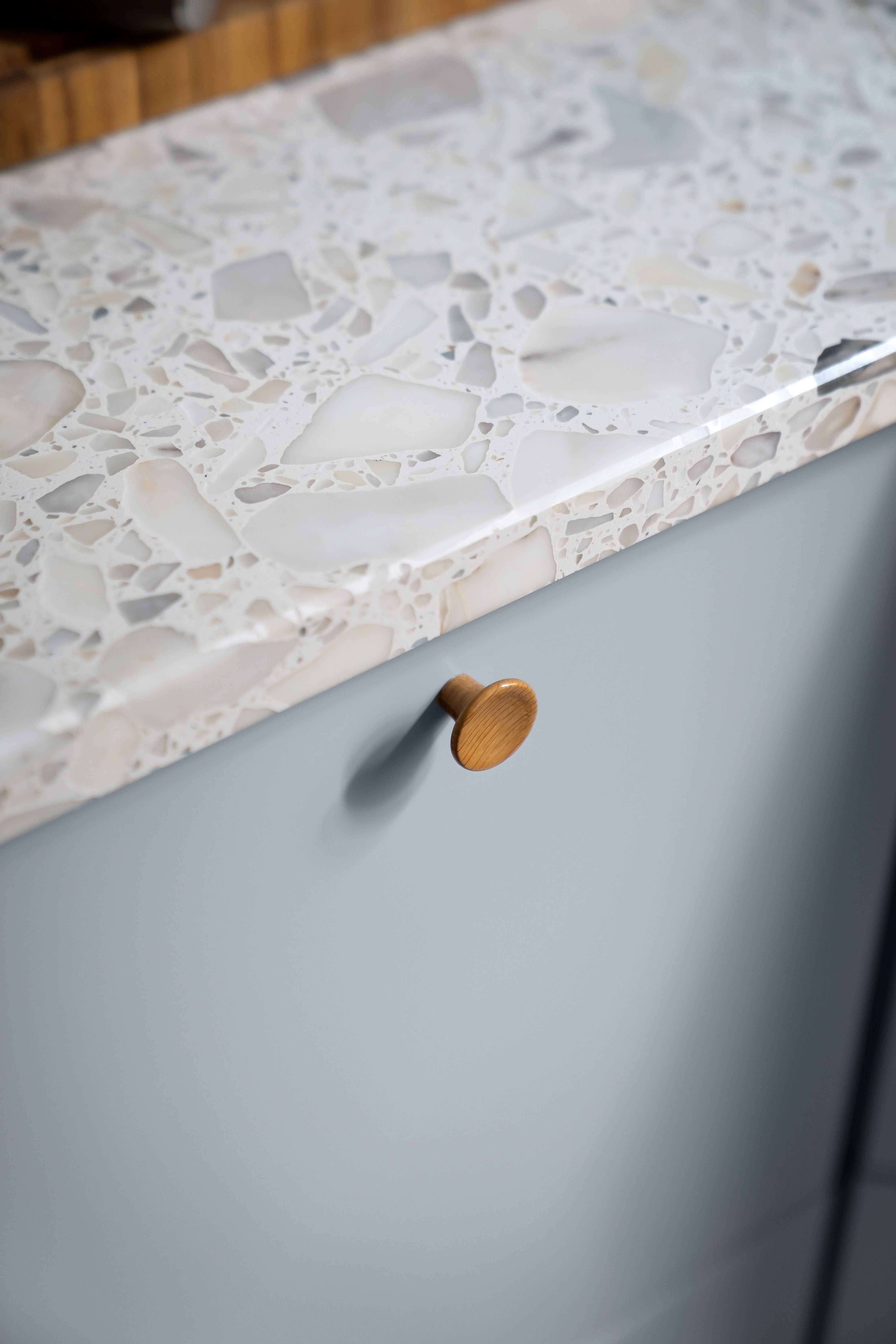
Reference photograph — a slim square edge sitting light over a flat cabinet door
Edge & thickness
A 20mm shadow edge and a mitred 40mm are two different kitchens
Thickness is read before colour. A 20mm slab with a square or shadow edge sits light on the joinery and suits handleless doors and a minimal, contemporary run — it also keeps slab consumption down, because you are buying surface rather than folded edge. A mitred 40mm profile is the same material returned at the edge to look like a solid block: heavier, more traditional in feel, and dependent on a pattern that runs convincingly through the join. Movement-heavy veining that stops dead at the mitre is the most common disappointment in a stone kitchen.
The cost difference sits in fabrication hours, not just material, so ask for both profiles to be priced against the same slab. On an island, a deeper drop edge exaggerates the effect again and any generous overhang for seating needs concealed support designed in with the cabinetry rather than added at install.
Details that decide the finish
Joins, sinks and upkeep
Join placementAgreed at templating
Sink typeUndermount or drop-in
Splashback junctionTile or slab return
SealingPorous stone only
Daily careBoard, trivet, wipe
Joins are the detail people notice for years, so decide where they fall on the plan rather than on the day: behind a cooktop or at a corner reads as intended, while a seam mid-island rarely does. Sink choice follows the material — an undermount needs a surface that can be polished at the cut-out, and laminate generally cannot oblige. Where the bench meets the wall, agree early whether tile runs down to the stone or a slab returns up the wall, because it changes both the setout and the order of trades.
Next step
Settle the slab while the design is still on paper
Benchtop material sets the edge profile, the sink, the splashback junction and a fair share of the budget, so it belongs in the design and quote stages rather than after demolition. Send us your room dimensions and the look you are after and we will put material options against a real measure — or use the contact form if you would rather ask a question first.
No obligation
Read next