Home / Kitchen Guides / Kitchen Cabinet Ideas, Doors & Finishes
Murrumbeena VIC — Kitchen guide · Doors, finishes & hardware

Cabinet doors, finishes and the hardware behind them.
A kitchen is read almost entirely through its doors. They are the surface your eye lands on from the hallway, the surface your hand touches forty times a day, and the single largest share of the joinery cost. This guide covers the four door profiles worth knowing, how the common finishes behave over time, how handles are sized and placed, and why runners and hinges decide what the room feels like five years in.
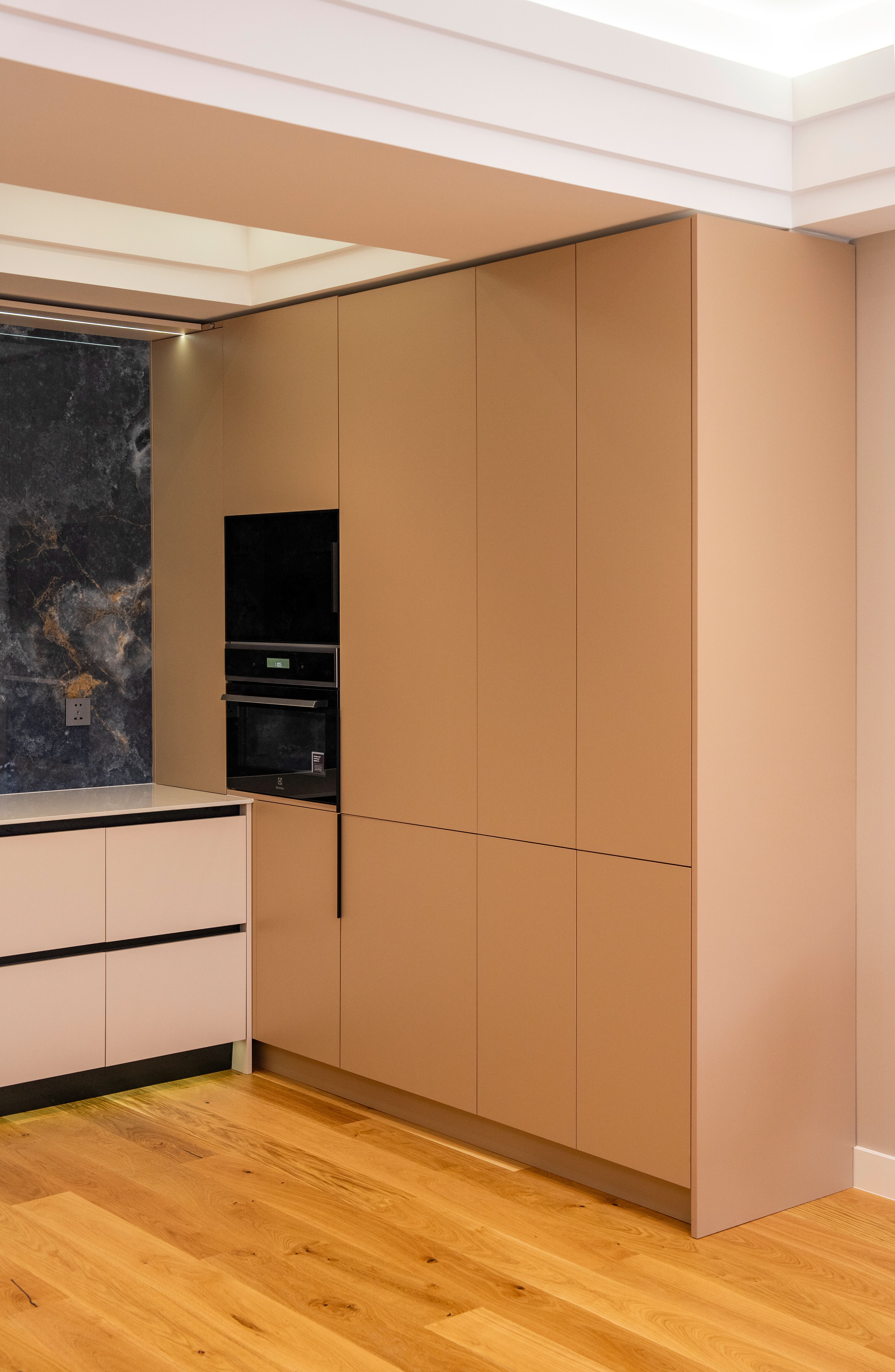
Contemporary kitchen with tall matte tan cabinetry, integrated black ovens, dark stone wall panels, pale lower cabinets, concealed handles and timber flooring.
Reference photograph — tall matte fronts, integrated ovens and a paler base run beneath

Six decisions, in the order they arrive

Cabinet choices feel endless until they are separated out. In practice there are six, and each one narrows the next — profile decides which finishes are available, finish decides which colours are, and hardware is priced per drawer rather than per kitchen.

01  Door profileShape

02  Finish systemSurface

03  Sheen levelLight

04  Colour planOne tone or two

05  HandlesProfile & placement

06  Runners & hingesHardware

Four door profiles worth knowing

01  Handleless shadow lineFlat front · Routed rail

A continuous recess above each drawer replaces the handle, so a long run reads as one unbroken plane. It suits wide, flat fronts and demands accurate setout — the shadow is only ever as straight as the carcasses behind it. Best where you want the benchtop and splashback to carry the room.

02  Classic shakerFramed · Recessed panel

A five-piece door with a recessed centre panel, forgiving in the period homes common through Murrumbeena, Carnegie and Ormond. Frame width changes the character more than most people expect: narrow rails read contemporary, wide rails traditional. It takes a knob or a bar handle equally well.

03  Flat panelSlab · Handle applied

A single slab front with an applied handle. The simplest door to make well and the most dependent on finish quality, because there is no moulding to distract the eye from a rough edge, a lifting band or a wavy substrate.

04  Timber veneerGrain matched

Real timber laid over board, with grain able to run continuously across a tall bank or an island end. It warms a scheme of pale stone immediately, and usually works hardest when used on part of a kitchen rather than all of it.

Three finish systems, compared honestly

Two-pack polyurethaneSprayed colour

Colour sprayed over sealed MDF, so edges and profiles are seamless and any colour is possible. It can be repaired and, years later, resprayed. It sits at the higher end of door cost and can chip on exposed corners if it is knocked hard.

Melamine boardEdge banded

Decorative surface bonded to board and edged with matching tape. Hard-wearing, stable, and available in convincing woodgrains and textured finishes. The edge band is visible at close range, and profiled doors are not possible — it is a flat-panel material.

Vinyl wrapPressed film

A film pressed over a routed MDF door, which makes shaker and profiled fronts affordable. Its weakness is heat: doors immediately beside an oven or dishwasher need heat deflection detailed properly, or the film can lift at those edges over time.
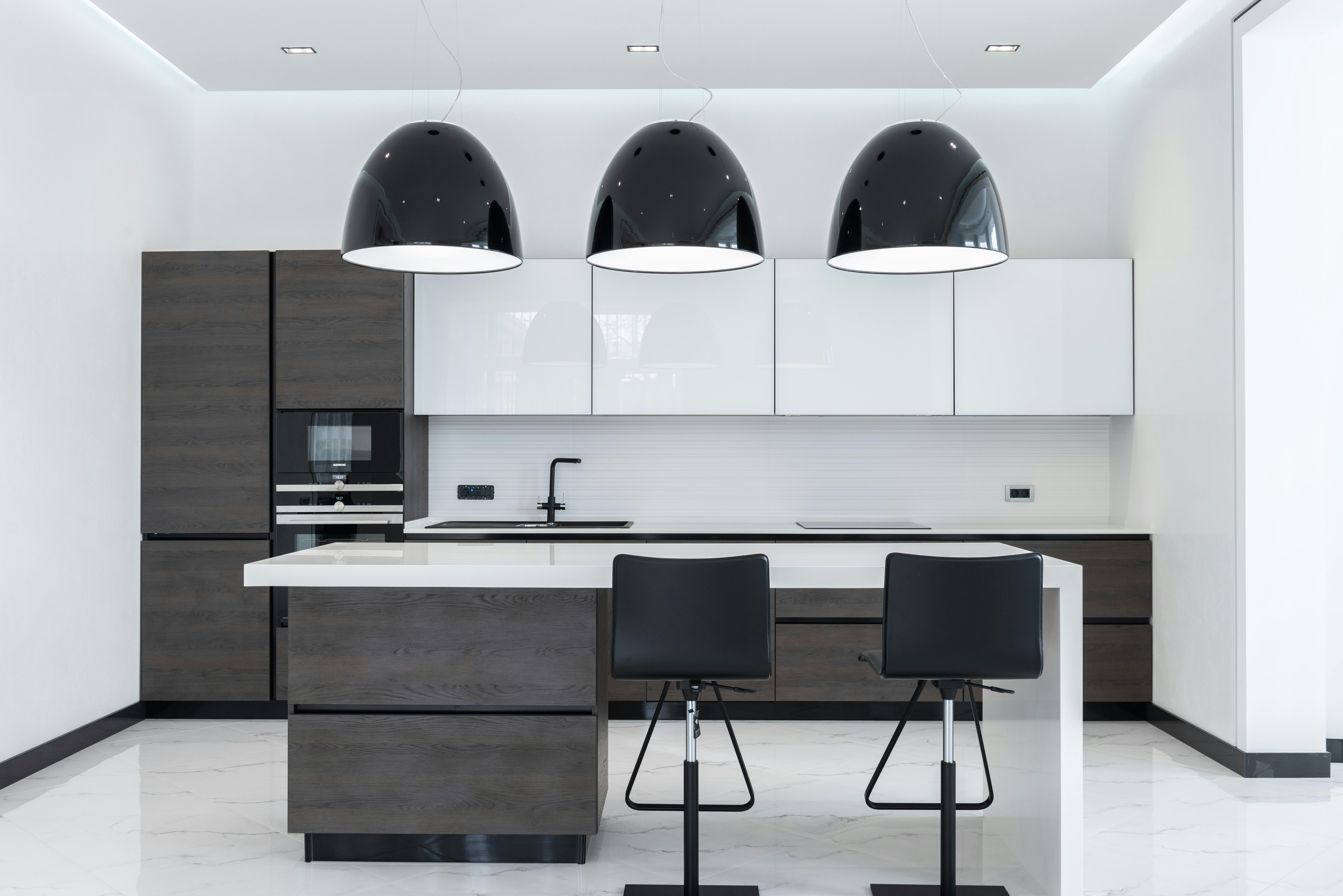
Contemporary minimalist kitchen with dark timber cabinetry, glossy white overhead cupboards, integrated appliances, a white island and three black pendant lights.
Reference photograph — timber grain below, sprayed gloss above: two finish systems in one room

Sheen and two-tone schemes

Matt absorbs light and flatters colour, but on deep charcoals and navies it shows fingerprints unless you specify a fingerprint-resistant surface. Satin is the middle position and the one most kitchens end up on: enough reflection to lift a north-facing room, not enough to mirror the ceiling downlights. Textured woodgrain hides daily marks better than anything else, which is why it earns its place on a tall bank beside a back door.
Two-tone works when the darker colour is grounded — base cabinets, an island, a single tall bank — and the lighter tone carries the wall cabinets and the eye upward.

Handles: profile, size, placement

Bar / D handleMost forgiving

KnobShaker doors

Edge pullLow profile

J-pull / recessed railNear-handleless

Integrated shadow lineNo hardware

Scale is what separates a considered kitchen from a catalogue one. Handles should grow with the drawer they sit on — a short pull on a 900mm pan drawer looks apologetic and pulls unevenly under load. On doors, run handles vertically near the opening edge; on drawers, run them horizontally and centred, or set them consistently toward one end across the whole bank. Tall pantry doors take a long vertical pull that echoes the door height rather than a small handle floating in the middle.
Finish is easier: pick one metal and hold it across handles, tapware and, where possible, the appliance trims. Mixing two is a decision, not an accident — it needs a reason and a repeat.

Why runners and hinges decide year five

Nobody remembers the colour conversation five years on. What they notice is whether the deep pan drawer still runs out level when it is full, whether the door beside the fridge still lines up with its neighbour, and whether the soft-close still closes rather than bouncing. That is hardware, and it is specified per drawer and per hinge — not as one line called ‘quality fittings’.
Three things are worth reading on any quote. Runners should be full-extension and undermount, so the whole drawer comes out and the mechanism stays hidden; side-mount runners cost less and show. Load ratings matter where crockery and pots live — a 30kg runner under a pan drawer is the part that fails first. Hinges should be adjustable in three planes so gaps can be trued after the house settles, and rated for a sensible cycle count.
The practical rule: if a budget has to give somewhere, give on the colour system before the hardware. A repaint or a respray is possible later. Replacing runners through a finished, stone-topped kitchen is not a small job. Bring your shortlist of profile, finish and hardware to a kitchen cabinets conversation, and where the walls are out of square or the pantry needs to be made to measure, to custom cabinetry.
Murrumbeena VIC — Next step

Bring the door, finish and hardware shortlist to a quote.

Tell us the room, the look you are after and roughly what you want to spend, and we will set the cabinetry out as a written scope — profile, finish system, hardware and all. You can also contact us with a question first.
No obligation