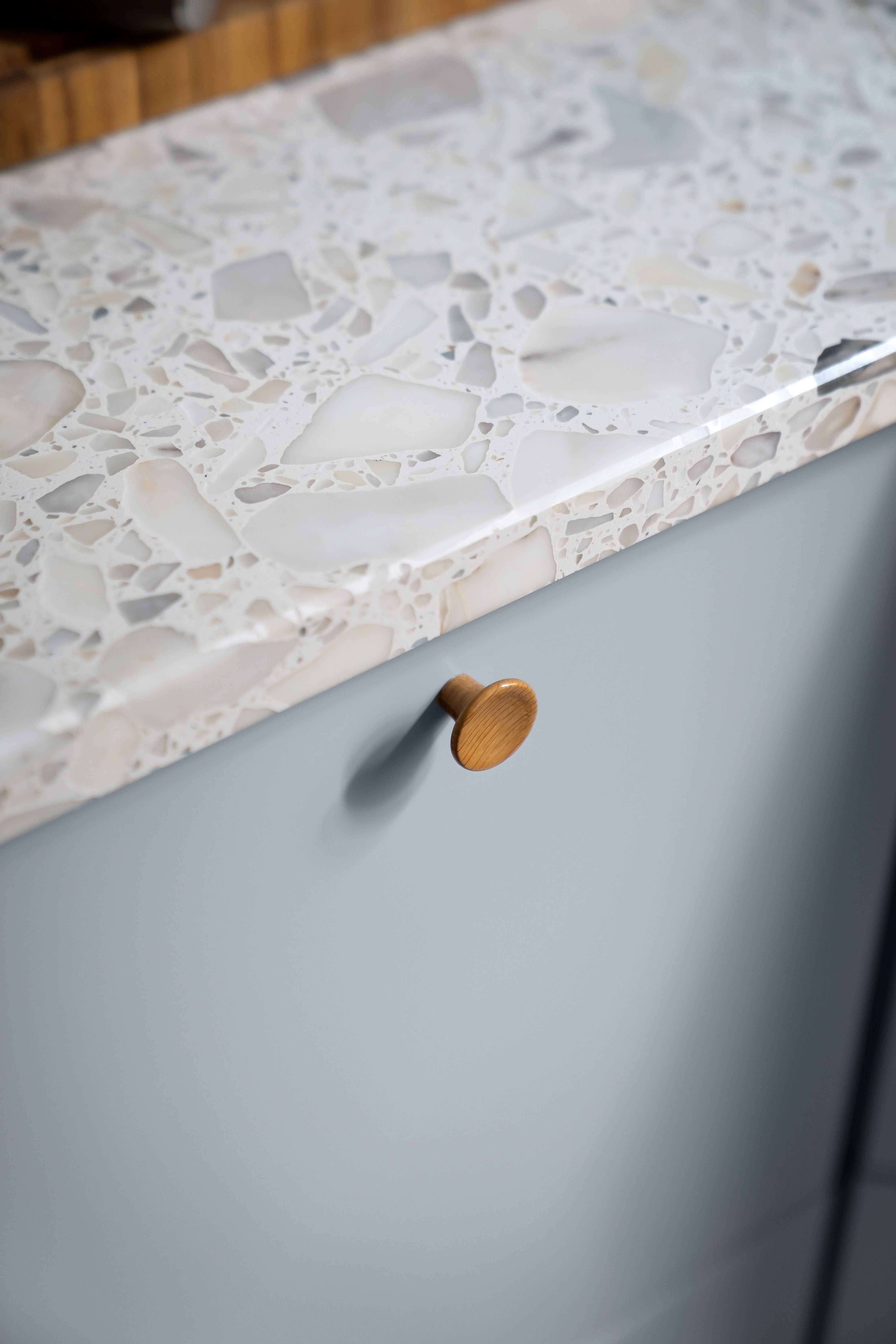
Reference photograph — benchtop edge profile meeting a cabinet door below
Home / Kitchen Renovation Services / Kitchen Benchtops
08 Murrumbeena VIC — Scope of works
Kitchen benchtops chosen for how they live, not how they photograph.
The benchtop is the surface a kitchen is judged on every day and replaced almost never. Material, thickness, edge profile and the position of every join are settled during design; the slab itself is only templated once the cabinetry is standing, packed and level. This line item covers selection, fabrication detail and installation across Murrumbeena and the surrounding south-east suburbs.
No obligation
Section A — Material schedule
Five benchtop materials, compared on the things that decide the choice.
Durability, heat tolerance, stain behaviour and ongoing maintenance separate these surfaces far more than price alone does. The notes below are written as a schedule — read the row that matches your cooking, then take the detail further in the Benchtop Materials guide.
01 Engineered stone · Stone
Consistent colour and pattern across slabs, non-porous and forgiving of wine, oil and citrus. It dislikes direct heat, so a trivet habit matters. Mitred ends and fine edge details cut cleanly in this material, which is why it suits waterfall islands.
02 Porcelain · Sintered
The most heat and scratch tolerant of the group, available in very thin profiles with a mitred build-up for a thicker look. Pattern runs through the surface layer, so exposed edges are detailed carefully at fabrication.
03 Natural stone · Quarried
Marble, granite and quartzite each behave differently. Veining is unique to the slab and worth viewing in person before it is cut. Porous stones are sealed and will patina with use — a fair trade for some owners, a dealbreaker for others.
04 Timber · Joinery
Warm underhand and repairable by sanding, timber works beautifully on an island or a secondary run. It needs oiling, and it is kept away from the sink surround unless the detailing and sealing are handled properly.
05 Laminate · Pressed
Modern laminate carries convincing stone and timber prints with tight seams and square-edge options. It keeps budget available for better cabinetry and hardware — often the right call in a rental, a unit or a staged renovation.
Note
Material is rarely chosen in isolation. The door finish decides how much the benchtop should say — see Kitchen Cabinets — and the wall behind it either continues the slab or changes material entirely, which is settled under Kitchen Splashbacks.
Section B — Thickness & edge
Thickness, edge profile and mitred waterfall ends.
A 20mm top reads light and contemporary; a 40mm mitred build-up gives the same slab weight and presence without doubling the stone. Thin 12mm porcelain profiles suit a minimal room, and a chunky 60mm island edge turns the benchtop into the architecture of the space.
The edge profile is a small decision with a long life. A pencil round is quiet and comfortable, a square arris is crisp and modern, a shark-nose or bevelled edge reads sharper again. Softer profiles are easier to live with on a busy family island.
Waterfall ends are mitred so the vein or pattern turns the corner and continues down the leg. That match is set out at the slab, not at installation, which is why layout is agreed before cutting begins.
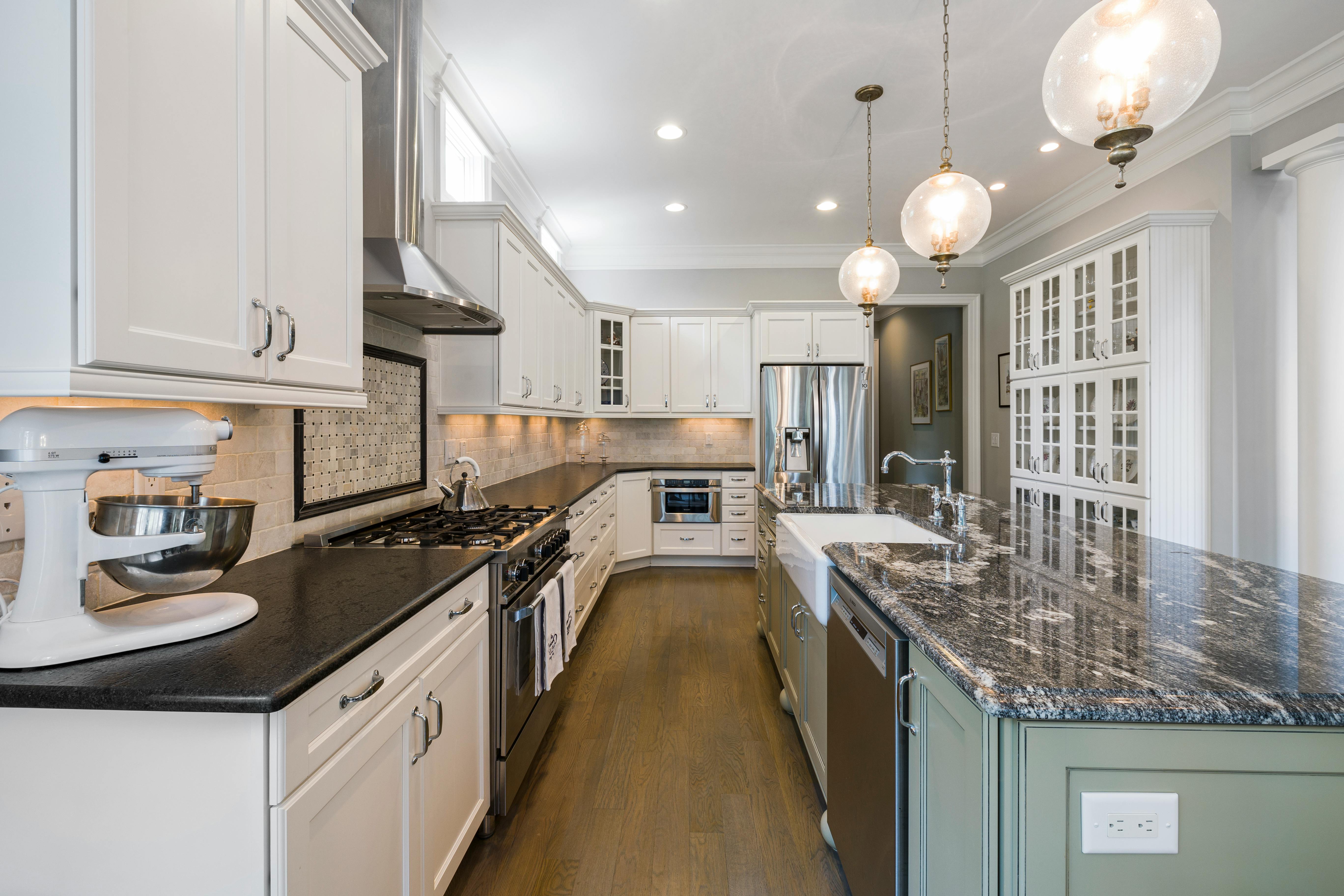
Reference photograph — a dark stone benchtop run carried around a central island, where thickness, edge profile and end detail are read
Section C — Cut-outs, joins & slab layout
Where the sink sits and where the joins land.
Three details separate a benchtop that looks fabricated from one that looks resolved: how the sink meets the stone, where a join is allowed to fall, and how the slab is laid out before anything is cut.
01 Undermount · Stone only
Crumbs sweep straight into the bowl and the top stays uninterrupted. Requires a hard, non-porous surface and a polished internal cut-out edge.
02 Drop-in · Any surface
Practical and economical, and the only option on most laminate tops. The rim sits proud, so sealing and a clean silicone line matter.
03 Joins · Placement
Slabs have a finite size, so long runs and returns need a join. It is placed away from the sink and cooktop cut-outs, kept off the island face where possible, and colour-matched at fabrication.
04 Slab layout · Setout
On veined material the pieces are nested so the pattern runs in one direction and book-matches across the island. Tall joinery and appliance openings from custom cabinetry are allowed for in the same setout.
Section D — Templating sequence
Benchtops are measured from the cabinets, not from the drawing.
i Cabinetry installed · Stage 08
Carcasses are fixed, packed and levelled, and appliance openings are confirmed on site. Nothing is templated until this is signed off.
ii Digital template · On site
Walls in older Murrumbeena and Carnegie homes are rarely square. The template records the room as it actually is, including the sink and cooktop positions and the tap hole.
iii Fabrication · Off site
Cutting, mitring, polishing and cut-outs are completed in the workshop. This is the gap in the program that owners feel most, so it is written into the schedule from the start.
iv Install, then splashback · Stages 08–09
Tops are set, joined and sealed, plumbing is reconnected, and only then is the wall behind measured. The full sequence sits in our 12-step renovation process.
Section E — Care & sealing
Living with the surface.
Does every benchtop need sealing?
No. Engineered stone, porcelain and laminate are non-porous and need no sealer. Marble, limestone and some quartzites are sealed on installation and topped up periodically. Timber is oiled rather than sealed.
What ruins a stone benchtop fastest?
Hot pans placed straight onto engineered stone, and abrasive or bleach-based cleaners on any polished surface. Warm water, a soft cloth and a pH-neutral cleaner handle almost everything else.
Can a benchtop be replaced on its own?
Often yes, where the cabinets are sound and square. It is a common scope within a kitchen makeover, usually paired with a new splashback because the old one will not line up with the new profile.
How is the material decision made?
During design, against how you cook and what the joinery is doing — see Kitchen Design. Slabs are worth viewing before selection, and questions outside this page can go through contact.
08 Kitchen Benchtops — quote
Send us the room and the material you are leaning toward.
A benchtop quote is written against real lengths, returns and cut-outs, so the more you can tell us about the kitchen, the more useful the figure. Free and without obligation.
No obligation
Read next: Benchtop Materials Compared, then Kitchen Splashbacks and Kitchen Cabinets.